January 29, 2026
Mission and Ministry at SCS: Where We’ve Been, Where We’re Going
by Jamie Kralovec

The School of Continuing Studies (SCS) has played an important role in helping the Office of Mission and Ministry at Georgetown evolve and adapt to serving the spiritual and religious needs of students from a diverse array of communities throughout their academic and professional careers.
As the School has grown in recent years into a truly dispersed global population of learners–especially at its first dedicated building on 640 Massachusetts Ave. NW–Mission and Ministry has had to innovate the ways that it animates Georgetown’s Catholic and Jesuit heritage and multi-faith commitments. The lessons from the SCS experience of inspiriting Georgetown’s Jesuit values into all aspects of the School’s life are now helping to inform Mission and Ministry strategies for engagement, accompaniment, and encounter on the emerging Capitol Campus.
Growing Mission and Ministry at SCS
The pillars of the SCS approach take their cues from St. Ignatius of Loyola, Georgetown’s patron and the founder of the global Jesuit religious order. Serving for 16 years as its Superior General, St. Ignatius was especially known as a military veteran, adult learner, and technologically-fluent leader (the technology of his day being handwritten letters). Drawing from his powerful example, SCS approaches mission integration in creative, inclusive, market responsive, and technologically-savvy ways.
The key to the strategy, like all sound teaching and learning in the Jesuit tradition, is to root programs, services, and opportunities in the particular context of each audience. Whether students are engaging online, in immersive residencies around the world, or in-person on the growing Capitol Campus, SCS invites its learners to realize their professional goals with the support of discernment resources arising from the Ignatian spiritual tradition.
At SCS, Jesuit values and interreligious understanding are intentionally woven into curriculum design and delivery, management culture, student experience, and mission-driven external partnerships and community engagement. The fruit of these efforts has borne out in myriad ways; in fact, SCS has gained a reputation within the university and throughout the larger Jesuit education network for its innovative and creative methods of integrating mission, values, and spiritual practices.
One particularly novel expression of this technologically-inflected approach is the creation of a strategies guide for integrating Jesuit values into online and on-campus courses. This guide informs the formulation of each and every new online course by mapping one or more of the ten Spirit of Georgetown values onto the learning activities of the class.
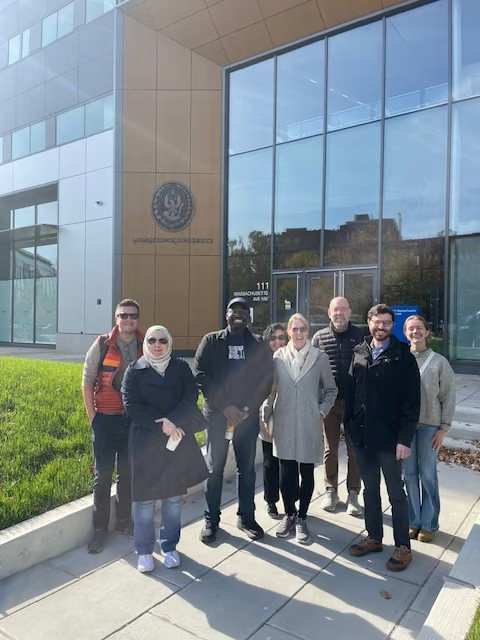
The composition of other courses at SCS also explicitly engage with particular Jesuit values. This is most evident in the core Ethics course required of all Master of Professional Studies students, as well as electives such as “Jesuit Values in Professional Practice,” a community-based learning course introducing the Spirit of Georgetown through volunteer service in the neighborhoods surrounding Capitol Campus.
“[The] exposure to the Jesuit emphasis on a person’s holistic development encouraged me to think broadly, and from a spiritual perspective as I work to reorient my career,” says John Lauinger, a current student in the Master’s in Urban & Regional Planning (URP) program.
Such mission integration pushes students to engage on a deeper level and to consider other perspectives they would not have done otherwise–leaving an indelible mark on both their personal and professional growth.
Anna Harty, another URP student who also works as a clinic office manager at Georgetown Law, reflects on an eye-opening course about faith-based organizations in downeast D.C.
“It reaffirmed my desire to pursue a career in urban planning dedicated to social justice, grounded in my experience with Jesuit education and values,” Harty says. “The course readings and discussions also sparked my interest in approaching urban planning as a kind of spiritual practice that involves intentional, dynamic engagement with community members and the city.”
Expanding Beyond Degree Programs
It is not only degree-seeking students who benefit from these coursework connections. Non-degree students in certificate programs like the Master Practitioner in Leadership and Strategic Thinking & Leadership, as well as high school students in pre-college programs like the Summer College Immersion Program (for rising seniors from the Cristo Rey Network, the KIPP Foundation school systems, as well as other community-based organizations), receive presentations about the principles of Ignatian spirituality and their relevant application for reflective professional practices.
The work of Mission and Ministry at SCS particularly shines in the area of retreats. A hallmark of the Jesuit spiritual accompaniment strategy post-Vatican II, retreats are modeled on the dynamics of St. Ignatius’s “Spiritual Exercises.” They have become a regular, often-anticipated occurrence for SCS students. Whether it takes place in daily life, or a weekend away at Georgetown’s Calcagnini Contemplative Center in Bluemont, Virginia, these religiously inclusive retreats help students pause and more deeply reflect on leading lives of meaning, purpose, and belonging.
Mission and Ministry-related opportunities for engagement are also offered to staff and faculty. Melissa Netzband Wathen, an SCS public services librarian, reflects on the “Ignatian Tradition” seminar that was a foundational experience early on during her tenure at Georgetown.
“In my time working at SCS, both at 640 and 111 Mass. Ave., I have found that my continued education in Jesuit core values has drastically shaped my day-to-day life at Georgetown,” Wathen says. “It is because of this seminar that I have a foundational understanding of what Georgetown truly stands for in its mission. That mission shows up in my work every day in how I approach student research consultations, in my relationships with my colleagues, and in my own professional practices.”
Finally, with a spirit of creativity and adaptability, Mission and Ministry at SCS has taken these spiritual resources online, offering virtual formats for regular meditation, workshops, and community listening circles.
Invigorating Possibilities at Capitol Campus
The growth of Georgetown’s Capitol Campus represents an exciting inflection point in the development and further integration of Mission and Ministry at SCS. The campus’s status as an interdisciplinary hub makes it an even more attractive destination for professional learners seeking to increase their impact in meeting social and marketplace needs. With a nexus of so many SCS programs focused on sustainable and equitable urban development, alongside other programs housed at Capitol Campus with similar profiles, the growing downtown campus can advance the University’s Catholic and Jesuit heritage, mission, and identity in new and needed ways that serve the city, the nation, and the world.
Mission and Ministry will be at the center of this collaborative potential, anchoring and guiding the development of the Capitol Campus in the mission-rooted lessons of St. Ignatius of Loyola. In Fall 2025, Mission and Ministry achieved a new milestone, opening the Mission and Ministry Multifaith Center on the fourth floor of 111 Massachusetts Avenue NW. Featuring a common area, offices for chaplains and staff, and a contemplative space for individual and group spiritual activities, this hospitable space promises to become a focal place of community building.
Mission and Ministry is well-suited to make durable connections not only within the Capitol Campus community, but also between the University and the city at large. As a strategic urbanist, St. Ignatius knew full well that a Jesuit institution proximate not only to the U.S. Capitol and the centers of national civic life, but also to the faith-based organizations serving the human needs of the poor, presents an amazing opportunity for our educational tradition at Georgetown to more greatly serve God’s glory and the well-being of humankind.