November 23, 2026
Lessons from Rasuwa: When Warnings Fall Short
by Frederic Lemieux, Ph.D
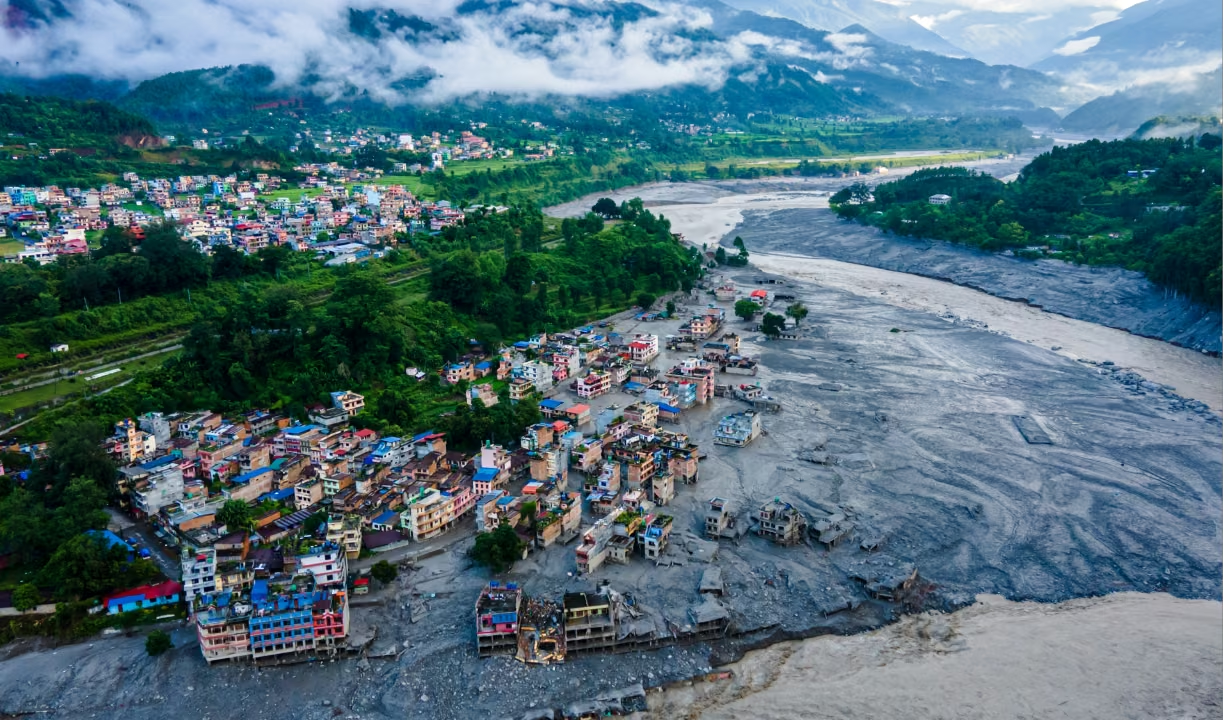
On the morning of August 26, 2026, Nepal experienced the deadliest extreme flow disaster in its recorded history. At 8:37 a.m., a mass of bedrock and glacial ice broke loose at roughly 5,200 meters on the north side of the Langtang range and crashed into the Lhende River on the Nepal-China border. The resulting surge traveled down the Bhotekoshi and Trishuli corridor at roughly 160 kilometers per hour, causing destruction more than 100 kilometers from its source (Lord 2026). When Nepal ended its search and rescue operations 40 days later, more than 1,400 people were confirmed dead and over 5,000 remained missing (ABC News 2026). The argument of this article is simple: the Rasuwa flood was not the failure of a single system, but the convergence of a changing hazard, growing exposure, and governance arrangements designed for neither.
A Cascading Disaster
Unlike most of Nepal's recent disasters, the Rasuwa flood was not triggered by monsoon rainfall or by an earthquake. Nepal's Department of Hydrology and Meteorology confirmed that no rainfall had occurred over the district that morning (EastMojo 2026). Instead, the avalanche gathered water and sediment as it moved and arrived downstream as a single, continuous debris flow, reaching the Chinese border facilities at Rasuwagadhi only 7.5 minutes after the slope failed. The border town of Timure and the market hub of Syaphrubesi were essentially erased, 19 bridges and 40 kilometers of highway were lost, and more than 430 megawatts of hydropower capacity, over 10 percent of Nepal's national supply, went offline (Lord 2026). The victims reflect the diversity of the corridor: Tamang residents, hydropower workers trapped in tunnels, security personnel in border posts, foreign trekkers, and hundreds of pilgrims bound for Mount Kailash. In other words, the flood did not strike an empty valley.
Lessons Learned
The first lesson concerns monitoring blind spots. Nepal's gauge and station networks were built to detect monsoon floods and glacial lake outbursts, not a rock-ice avalanche originating in a narrow strip of unpopulated territory that drains north into China (Lord 2026). Of roughly a dozen extreme flow events in the Himalaya over the past decade, only one occurred at a site already flagged as high risk. More troubling, a smaller glacial flood had struck the same watershed in July 2025, killing 19 people, yet that signal did not translate into readiness. Therefore, monitoring must become layered: (a) river gauges and weather stations as a foundation, (b) satellite and seismic detection for remote terrain, and (c) local observers, such as herders and mountaineers, who often notice change long before a sensor does.
The second lesson concerns the gap between warning and action. The flood destroyed the Syabrubesi river gauge at 8:50 a.m., and the official alert went out 38 minutes after the collapse (Kathmandu Post 2026). With communication towers down, residents went door to door to warn one another, and many survivors escaped by luck rather than by design. However, a warning only saves lives when people know how to act on it, which requires evacuation plans, community drills, and trusted local messengers (Pamir Times 2026).
The third lesson is transboundary. The hazard originated in Tibet and crossed into Nepal within minutes, yet when a similar flood struck in 2025, Nepal received no advance notice from China because no formal notification mechanism existed (The Himalayan Times 2026). Since August, new channels of communication between Chinese and Nepali authorities have opened, a welcome but belated development (Lord 2026). Mountain hazards do not respect borders, and early warning cannot either.
Finally, the fourth lesson concerns exposure. In recent decades, the Trishuli corridor has concentrated hydropower plants, customs facilities, guesthouses, and a major pilgrimage route in steep, narrow valleys. In 2026, the auspicious Fire Horse year drew unusually large numbers of pilgrims toward Kailash during the monsoon (The Spectator Australia 2026). Hazard cannot be eliminated, but exposure can be managed through land-use regulations, siting standards for critical infrastructure, and seasonal controls on high-risk routes. The October 11 flash flood on the Budhi Gandaki in Gorkha confirmed that the risk persists. This time, however, SMS alerts and evacuation orders reached communities quickly, which suggests that some lessons are already being learned (Boldsky 2026).
Preparing Tomorrow's Emergency Managers
At Georgetown University's School of Continuing Studies, the Master's in Emergency & Disaster Management program prepares professionals for precisely these challenges. Several courses directly address these areas, including Natural Hazards and Disasters and Climate Change,which examine how cascading hazards are reshaping risk, while GIS for Emergency & Disaster Management builds the spatial literacy that layered monitoring requires. Risk Perception Awareness addresses the gap between warning and action, Hazard Mitigation Planning tackles exposure, and International Humanitarian Disasters and Post-Disaster Recovery prepare students to lead across borders. Rasuwa reminds us that the next disaster rarely looks like the last one, underscoring the importance of preparing professionals to navigate increasingly complex and unpredictable disasters.
References
ABC News. (2026, October 7). “Nepal ends search for thousands still missing after deadly floods” [Video]. https://abcnews.com/video/137063885
Ali, A. (2026, September 5). “Nepal’s Rasuwa flood: A warning for Pakistan’s mountain communities”. Pamir Times. https://pamirtimes.net/2026/09/05/nepals-rasuwa-flood-a-warning-for-pakistans-mountain-communities/
Bierling, B. (2026, August 30). “Nepal must learn from the Rasuwa floods”. The Spectator Australia. https://www.spectator.com.au/?p=10939849
Boldsky. (2026, October 11). “Nepal flash flood: What happened in Gorkha’s Budhi Gandaki and what we know so far.” https://www.boldsky.com/insync/nepal-flash-flood-what-happened-in-gorkha-budhi-gandaki-and-what-we-know-so-far-173297.html
Karki, C. (2026, September 6). “The rising threat from the roof of the world: Nepal’s Himalayan glacier disaster demands urgent action.” The Himalayan Times. https://thehimalayantimes.com/opinion/the-rising-threat-from-the-roof-of-the-world-nepals-himalayan-glacier-disaster-demands-urgent-action
Lord, A. (2026, September 4). “Nepal’s latest disaster signals a need to redesign monitoring and early warning systems”. New Security Beat. Stimson Center. https://www.newsecuritybeat.org/2026/09/nepals-latest-disaster-signals-a-need-to-redesign-monitoring-and-early-warning-systems/
Poudel, S. (2026, September 2). “Nepal sent its disaster alert 38 minutes after the glacier collapse. It wasn’t enough”. The Kathmandu Post. https://kathmandupost.com/national/2026/09/02/nepal-sent-its-disaster-alert-38-minutes-after-the-glacier-collapse-it-wasn-t-enough
Team EastMojo. (2026, August 27). “Nepal’s flash flood is a warning the Northeast cannot ignore: Here’s why”. EastMojo. https://eastmojo.com/premium/2026/08/27/nepals-flash-flood-is-a-warning-the-northeast-cannot-ignore-heres-why/