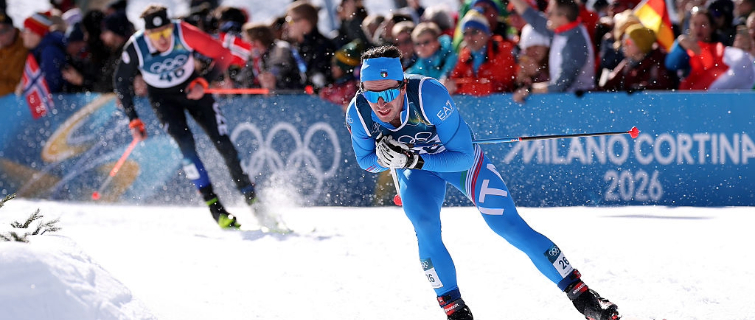
February 2026 will be remembered as a month when a vision of the future of global sports was on display.
The shortest month of the year had a lengthy list of prominent sports events. In the United States, there was the NFL’s Super Bowl LX in Santa Clara, CA; the NBA All-Star Weekend in Los Angeles; and NASCAR’s Daytona 500. In Europe, the events included the rugby union’s Six Nations Championship and football’s UEFA Champions League knockout phase playoffs in various locations. In Asia, cricket’s ICC Men’s T20 World Cup commenced in India and Sri Lanka, and horse racing’s Saudi Cup was held in Riyadh. Golf, tennis, and other professional sports also had notable tournaments on their respective women’s and men’s tours.
All of them were dominated by the commanding spectacle of the Milan Cortina Winter Olympics in northern Italy. Over the Games’ two weeks, record numbers of broadcast and streaming viewers tuned in while waves of in-person fans marveled at the intense competitions and medal-winning performances. Athletes who competed, fans who watched, media who chronicled, and everyone who connected with the 2026 Games in some way were all witnesses to a trailblazing presentation.
Milan’s Impact Using Multiple Venues
As widely reported by NBC Sports and scores of other media entities, how the Games were staged produced a lasting impact as notable as the Olympic medal count.
In the 2026 Winter Olympic Games, there were 116 events showcasing 16 winter sports, spread across multiple locations in northern Italy. These Games were the most geographically spread out in Olympic history, and, for the first time, there were two cities serving as the official hosts for a Winter or Summer Games. Indoor events, including hockey, speed skating, short track, and figure skating, were staged in Milan, while sliding events such as bobsled, luge, skeleton, and curling were conducted almost 250 miles away in Cortina. Men’s alpine skiing and ski mountaineering events took place in Bormio, and freestyle skiing and snowboarding events were contested in Livigno. In total, there were 15 competition venues across nearly 8,500 square miles.
Getting from one destination to another could require hours-long rides over mountainous routes in some combination of cars, buses, and trains. The layout was widely described as “scattered,” “inconvenient,” and “disconnected”, and yet “successful.” This model could very possibly be how Olympics and other mega-sports events might look in the future. For example, the next Winter Olympics in 2030, which will be officially held in the French Alps, can be expected to be even more spread out with clusters of venues dotting areas throughout southern France.
Why?
The International Olympic Committee’s priorities on cost management and a commitment to sustainability.
A Sustainable Future for the Olympics
Because it has become increasingly cost-prohibitive and operationally complex to build infrastructure and provide services to host the Olympics in small mountain towns and ski resorts, the IOC has struggled to attract bids from prospective host countries. By spreading expenses and responsibilities among several host sites in Italy, it created cost, operational, and political efficiencies of which the IOC and its stakeholders took note.
An increased focus on sustainability and legacy by the IOC and a host country was another reason the 2026 Winter Olympics took place in multiple locations in northern Italy. The IOC and other sources reported that close to 90% of the competition venues already existed, with plans to repurpose new facilities after the Games for uses ranging from sports to housing. Looking ahead to the 2028 Summer Olympics, a major benefit of the Games being hosted in Los Angeles is the number of existing venues that will be used for competition, marking the first time in decades that there will be no new permanent structures built for an Olympics.
Looking Ahead in Global Sports
It is fascinating to consider how future bids for hosting Winter and Summer Olympics, men’s and women’s FIFA World Cups, and other global events could be influenced by the philosophy the IOC stated: "Milano Cortina 2026 reflects this evolution through a more flexible, regionally distributed model that maximizes existing venues, reduces environmental impact, and strengthens community resilience."
The innovative staging of the 2026 Winter Olympics and its long-term operational and strategic impacts will serve as a powerful case study throughout global sports. Interested in building a career as a leader in the global sports industry? In our immersive, yearlong Executive Master’s in Global Sports Operations & Strategy program, you’ll analyze real-world events like this while developing the skills and perspective to make an immediate impact. Partnering with Manchester City Football Club, the program connects students with industry professionals and expert faculty to explore the business strategies and trends shaping growth in global professional sports—preparing you for a lifetime of leadership in the field.
Learn more


Bobby Goldwater
Bobby Goldwater, a veteran sports executive, serves as faculty director of the new Executive Master’s in Global Sports Operations & Strategy program, an innovative collaboration between the Georgetown University School of Continuing Studies and Manchester City Football Club, launching in fall 2026. He has spent 18 years as a faculty member in the Master’s in Sports Industry Management program and has extensive experience across the sports, entertainment, and venue management industry.