April 28, 2026
She Was There When They Came Home
by Carol Blymire

Georgetown alum Kristi Johnson led the U.S. Navy's communications for the historic Artemis II splashdown—and made the world watch.
When the Orion capsule carrying four astronauts broke through the atmosphere and splashed down in the Pacific Ocean on a golden April evening, 27 million people were watching on the six major networks. Another 29 million tuned in through NASA+, on streaming services, and on their phones. The footage was extraordinary—sweeping aerial shots, helmet-cam video from Navy divers, the first sunlit faces of the crew emerging after a week orbiting the moon in space. It did not happen by accident.
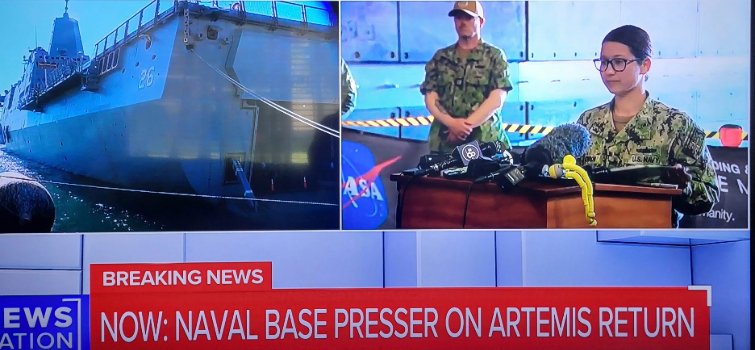
Behind every carefully framed image, every coordinated press access decision, every cleared shot that made it to air, there was a plan—and at the center of that plan was Kristi Johnson, a U.S. Navy public affairs officer and proud 2025 alumna of Georgetown University's Communications program.
"From the first time I went underway on the ship back in January with a few cameras as part of our testing and planning efforts, I was like, this is not enough," Johnson recalls. "We need more." She spent the months between January and April doing exactly that: building and refining a best-in-class communications team that collaborated with and closely supported NASA in capturing and sharing one of the most-watched moments in recent American history.
Building the Plane While Flying It

The Artemis II mission had already been delayed twice—from its original February launch window, then again from March—before finally lifting off in early April. For Johnson, each delay meant adjusting and rebuilding her team around shifting commitments and availability. "People had other obligations and timing of other missions kept happening," she explains. "So we were kind of building the plane as we were flying."
But the delays turned out to be a gift. Had the crew launched in February, the splashdown would have occurred at night with near-zero moonlight—a logistical and visual nightmare for any communications team. The April splashdown, by contrast, happened at golden hour. "I kept looking at the launch dates and the splashdown times," Johnson says. "When they finally moved it to April, I was like, oh my gosh. Golden hour. The PR gods were smiling."
By the time USS John P. Murtha left port a week ahead of splashdown, Johnson had assembled exactly the right team: photographers, communications specialists, and—crucially—a second and third public affairs officer. One handled production. One was dedicated to the media pool. Johnson took overall command. "That was the right mix of people," she says. "And I think we kind of nailed it."
The People Behind the Mission

One of the most emotionally resonant ideas that came out of Johnson's planning was deceptively simple: tell the story of the Navy sailors, not just the mission. "My colleague had this idea for the divers," Johnson recalls. "These astronauts are going to get back to Earth, and the first face they'll see is the face of a U.S. Navy sailor. Chef's kiss. Amazing."
The helmet camera footage from the Navy rescue divers—the sound of voices catching with emotion as they welcomed the crew home—became a popular and celebrated element of the entire splashdown coverage. It was a reminder that behind every historic mission is a community of people, many of them young, many of them doing their jobs without any expectation of recognition, who make the extraordinary possible.
That philosophy extended throughout Johnson's approach. When the Navy ship returned to port, roughly 10,000 visitors came aboard over three days just to see the capsule. Johnson watched as NASA engineers, Lockheed data collectors, and wide-eyed children all stood in front of the Orion crew module and were told the same thing: read books, be curious, pay attention in school. "All these little eyes were like—I want to do that," she says.
Johnson herself experienced one of the mission's most memorable moments when the four astronauts—who could have been resting on medical orders—instead came out to the flight deck to personally thank every sailor on the ship. "They were talking to the cooks, the engineers, the 19-year-old sailor who's been in the Navy for one year," she says. "For them to express that gratitude to everyone who had a part to play... we were all on the brink of tears. It was authentic, they meant it, and all four of them are gifted communicators."
Crisis Planning and Clear Agreements
Running communications for a mission of this magnitude required more than good instincts and great talent. It required meticulous planning (including myriad crisis protocols) and airtight agreements between multiple organizations—NASA, the Navy, and the national media pool—each with their own priorities, audiences, and institutional interests.
Johnson's approach was clear from the start: NASA was in charge. The Navy was supporting. "We made it very clear that NASA reserves the right to pull the plug on a live feed or any communications assets or strategy at any time," she says. "Protecting the astronauts was the number one priority. We all were in agreement on that.”
"Having a media crew at sea for six days is kind of unheard of," Johnson notes. "Normally, we do that for no more than 36 hours. So it really was a matter of establishing ground rules, making sure we all agreed on the limits and guidelines, and getting buy-in from the ship captain and from NASA." The result? Flawless execution under pressure, by every party involved.
The Georgetown Foundation
Kristi Johnson is a graduate of Georgetown University's Communications program—the program now housed in the School of Continuing Studies and built on the conviction that communications is a strategic discipline, not a tactical afterthought. It's a philosophy that is evident in everything about how Johnson approached the Navy communications support of Artemis II.
She didn't just think about what images to capture. She thought about trust — and how trust drives behavior, inspires recruitment, and shapes the way the public understands and values institutions like the U.S. Navy. She built a team structured around clear roles and accountabilities. She negotiated governance agreements across multiple organizations. She identified the human stories within the mission that would move people. And she managed, in real time, a live recovery-at-sea scenario involving a national broadcast network, a federal agency, and the world's most-watched spaceflight in decades.
That is strategic communications. Not spin. Not messaging. Strategic, evidence-based, relationship-centered communications—exactly what Georgetown's program is designed to produce.
What Comes Next

Johnson is already thinking about Artemis III. "There are certainly a lot of lessons learned on how we can make it even smoother," she says with characteristic understatement. In the meantime, she'll be heading to Fleet Weeks in Los Angeles and San Francisco, and spending time in Hawaii for the Rim of the Pacific Exercise—the largest international maritime exercises in the world. She does all of this while raising three children under seven with her husband, a Navy EOD officer.
Her kids, she reports, now know the names of all four Artemis II astronauts, can identify the parts of a rocket, and were brought aboard the ship to see the Orion capsule. Her six-year-old daughter interrogated a suit engineer about which spacesuit belonged to which astronaut and was distinctly unimpressed to learn that one of them had been left "in a heap on the table” while it was being processed for transport.
The apple, it seems, does not fall far from the tree.
Georgetown's Communications program is proud of Kristi Johnson—for what she accomplished on the USS John P. Murtha, for the way she leads, and for the example she sets for everyone who comes after her.
